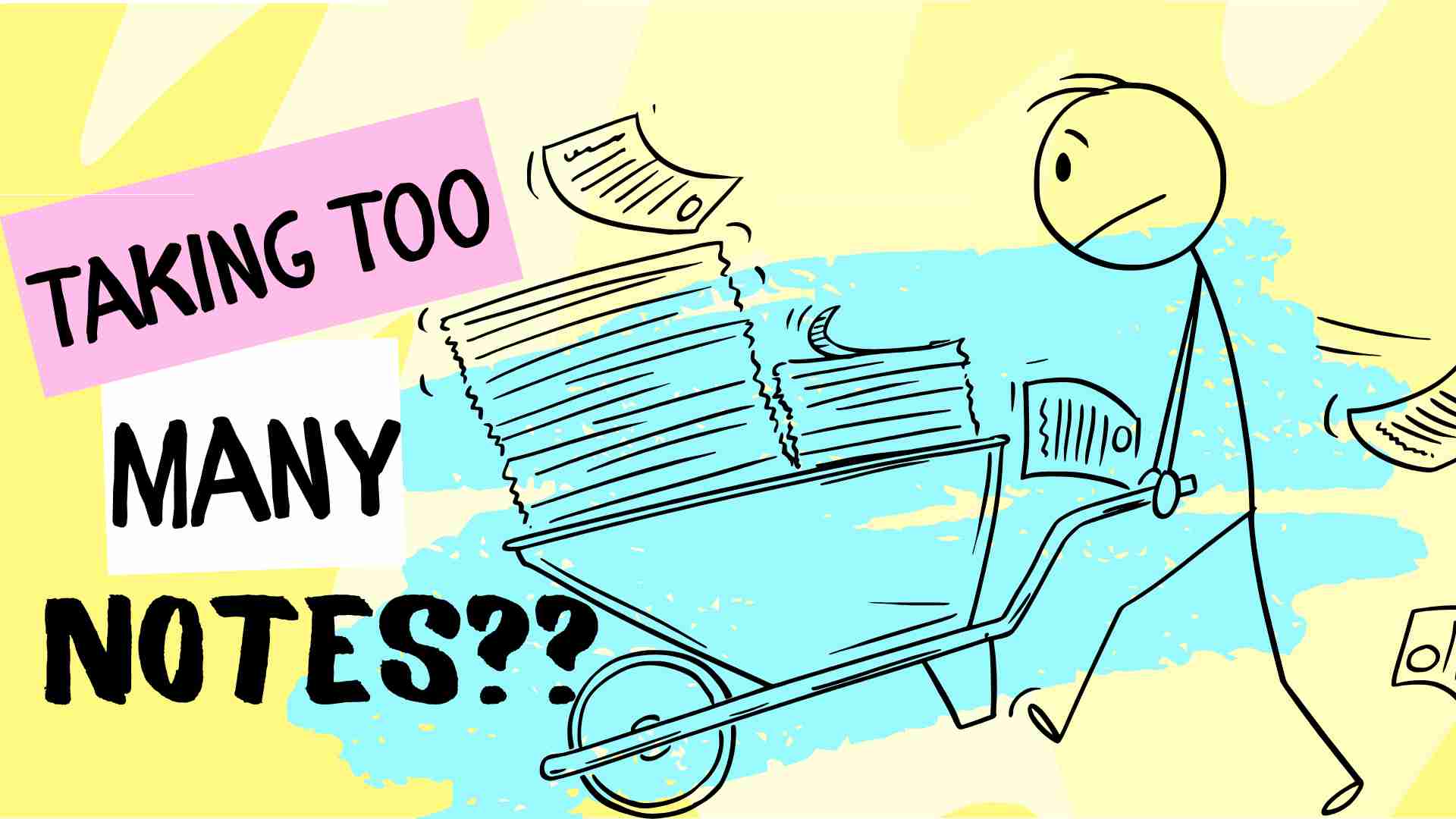
Let me guess, your brain is a leaky bucket, so you write everything down? You’re not alone. There is an army of us unitedly drowning in notes, all thanks to a poor working memory.
This aspect of our brain is one of the reasons we never have enough time; we’re trapped in a note-taking spiral.
What’s worse, many of us find we never look at those notes again. Can we find a common ground to this ADHD angst? Let’s tackle it together!
Table of Contents
- When a Poor Working Memory Fails You
- How Can I Stop Taking So Many Notes?
- Make Your Notetaking More Helpful
- Final Thoughts
When a Poor Working Memory Fails You
I thought it was just me, but when I cracked it open, many ADHDers struggle with copious amounts of notetaking.
From students to persons on the job, the endless paper trail is real. One man shared that when he was sent to retrieve items for a customer, even the shortest request required a list. This need left his manager puzzled and he asked the man, “Can’t you remember it?” To which he replied, “You would think so!”
Therapists with ADHD, taxed with taking session notes, also reveal they are guilty of excessive notetaking. Even when there is a designated notetaker in a meeting, most of us will opt to take our own.
Heavy documentation is all due to a poor working memory. According to Psychology Today, “Working memory is a form of memory that allows a person to temporarily hold a limited amount of information at the ready for immediate mental use.”
Having a poor working memory is blamed for things like forgetting what you went to retrieve in the garage once you got there, a new staff person’s name, or what was discussed in a meeting.
People with ADHD compensate for this by basing their entire life on notes, both in and outside of work.
How Can I Stop Taking So Many Notes?
The rest of the world might remember better from listening carefully, but there are plenty of others who – like us – do better from taking detailed notes.
Some individuals may even be chastized in the workplace for their notetaking marathons, even when there is an assigned meeting recorder. Luckily, your fellow ADHDers can swoop in and offer emotional support. Upper management and coworkers often don’t understand what it takes to pull off our day-to-day, but we do.
“I’ve got it all in my head” is a disaster waiting to happen.
-Reddit contributer
I’m here to say: keep taking your notes. Taking too many notes is only a problem when you’re more focused on your notes than the conversation in the meeting, or you’re investing hours retyping the notes later.
When your colleagues realize you’re always on top of things, don’t forget the small stuff, and are super productive thanks to your notes and to-do lists, the snide remarks will end. Inevitably, you will be the one these folks will come to when their own notes lack information.
The Power of Notetaking
The rest of the world might remember better from listening carefully, but there are plenty of others who – like us – do better from taking detailed notes.
Taking notes is also a way to keep your body busy so your mind doesn’t wander off mentally, it helps you to be a better active listener. Writing is thinking. It helps your brain to stay ‘in the moment’ and absorb information.
Writing notes in your own words creates better connections in your brain. Even if you never look at the notes again, you have learned through the physical hand, brain connection of taking them.
Beware Enablers That Bring You Down
Sadly, there are enablers out there. Platforms like Pinterest have us madly clicking every recipe, quote, and crochet pattern. Apps like Evernote assure we grab every tasty nugget of literary goodness. We use screenshots like a space-age weapon.
In the end, we are collectors of curiosity – it’s our downfall. All I can say is reducing screentime reduces our collections.
Make Your Notetaking More Helpful
How many of you take notes, and then never look at them again? Do you re-type your notes, fleshing them out even more afterwards?
Or are your notes strewn across random scraps of paper, and you forget where you wrote a vital piece of information? Ugh! The pain is real!
Before you think you can’t stay engaged, try this: have two or three notetaking methods available so that when you aren’t stimulated or engaged enough with the one you’re using you have a backup to switch to.
You do whatever you need to survive in this chaotic world.
-Reddit contributer
This includes apps, voice recordings, platforms like Google Keep, your phone, or any other method that appeals to you.
Here are more tips to help corral your endless note-taking:
Bold, Arrow, Highlight, and Circle
All of my scribbles are just scribbles without a visual anchor:
- Add a summary title at the top in bold marker; wrote down important key words
- Challenge yourself to write one sentence or three brief bullet points (no more than four words each) in your own words
- Highlight and circle key thought to keep track of, or action items
- Use a red pen to indicate action, or completion of a task
- Date the page so you have a reference in time when the notes happened
In summary, prioritize in the moment. These small actions make a big difference to having chicken scratches on a page vs. notes that jog my memory.
Keep Designated Notebooks
I have an admin meeting every Monday morning. It has been a game changer to keep a notebook only for that meeting. Each meeting starts a brand new page with a date on top.
In addition, I am armed with my tools for success: a yellow highlighter and a red pen. The task that are assigned to me are highlighted in yellow, the red pen tells me if I have completed them.
I tried this out with another regular meeting I attend – rinse, wash, repeat – success! Having designated notebooks assures I stop the nasty ADHD habit of writing down information on random sheets of paper.
Keep Visually Different Types of Paper
All of us, at one time or another, have grabbed any available paper (or napkin!) when thoughts start falling out of our heads. Unfortunately, it gives me anxiety to see a pile of loose notes at the bottom of my work bag that I need to clean out.
I’ve found it immensely helpful to visually divide those types of thoughts so I can refer to them later.
For example, if I find myself going down the rabbit hole of research, I grab lined loose-leaf paper. The paper is ONLY used for rabbit holes. This may lead to an eventual purchase, a blog post, or trying to figure out software, it doesn’t matter.
Colored legal pads are also helpful to differentiate my think fest. I found them effective for blog topics, big ideas, or marketing strategies for my website. These thoughts are really important to me to hold onto.
For each of these strategies, I get out my other tool for success: a black sharpie maker. I grab this to summarize what all the scribbles are about – because they are definitely scribbles. Sometimes I use a post-it note instead, to quickly clue me in what the page is about.
Another tip: date the page because it’s startling how long we hold on to these notes. For the loose leaf paper, I will either staple or paper clip the grouped sheets together to prevent orphan pages.
Sketchnotes
Sketchnoting is a creative way of taking notes that combines text with visuals like illustrations, symbols, and diagrams. Instead of just writing down information in a linear format, sketchnoting helps capture ideas in a more engaging and memorable way. It’s often used in meetings, lectures, and brainstorming sessions to make notes more visually appealing and easier to recall.
The technique was popularized by designer Mike Rohde in 2006 when he found traditional note-taking stressful and wanted a more effective way to retain information. His approach focuses on capturing key points rather than every word, using a mix of drawings and text to make notes more meaningful.
Before your shiney new thing excitement is activated, there are a few caveats. Sketchnotes are a great tool for visual thinkers. With that said, even artists can get distracted by trying to make their sketchnotes pretty (that goes for bullet journals, too).
This technique can soon be abandoned if you feel overwhelmed. Sketchnoting is meant to be messy and fast, not perfect. Give it a try, it’s great fun!
Final Thoughts
Own your glorious notetaking habits, don’t be ashamed of it! Instead, congratulate yourself that you are working with your brain, instead of against it.
Every small step forward counts!
#inthistogether -Renee