If you’re looking for unconventional ways to enhance your thinking, consider what clothing you wear. I’ve explored loads of rabbit holes that all prove what you wear affects your focus, productivity levels, and creativity.
Read on as I reveal all!
Table of Contents
- The psychology of clothing
- What do writer’s wear?
- What are the best clothes for studying?
- Foster more creative thinking
- Comforting clothes reduce anxiety
- The REAL Thinking Cap
- Conclusion
The psychology of clothing
The term “dress for success” means dressing for mental preparation. Whether it’s to land a job, or ace a presentation, clothes play a part in the outcome.
Science says that the clothes we wear affects our behavior, attitudes, personality, mood, confidence, and even the way we interact with others. Science Direct refers to this as “Enclothed Cognition“.
Enclosed Cognition is the experience of wearing something and it subtly affects our attitudes and our choice of behavior.
Social psychologist, Gauri Sarda-Joshi suggests power dressing (wearing power clothing makes us more feel more confident) can actually increase hormones needed for displaying dominance. This in turn helps us become better negotiators and abstract thinkers.
Suzan Bond shares her personal reflections in her article, “I dressed up every day for a month to see if I’d feel smarter.” It was as I suspected, she felt very out of place in meeting and Zoom calls with her dressed down-colleagues.
She did mention having an in-person meeting with the CEO of a startup. He was dressed nicely, too, and they connected right away.
As the tech support person at work, I dress up. No tan pants and polos for me. I’ve mentioned before that I work many roles at a nonprofit, but I prefer a higher standard in my appearance. Thus, when other techs are talking to me, they don’t realize I’m the tech person. Go figure.
Improve productivity and focus
The right clothing increases focus – and productivity. That’s what you’re here for, right?
An interesting research published in the Journal of Experimental Social Psychology back in 2012, showed a higher level of concentration with people who were told that they are wearing a doctor’s white coat.
The study participants wore a painter’s smock, whereas others wore doctor’s coats. The ones dressed in doctor’s coats displayed incredibly higher results in attention demanding tasks. So, next time you are lacking focus, simply put on a doctor’s coat and immerse yourself in that concentration demanding task.
However, in the article, “Does What We Wear To Work Affect Our Productivity?” casual dress in an office environment wins out. “According to studies, 61% of employees are more productive when the dress code is relaxed.”
Productivity is different than focus. Choosing the right “think” clothing for the right job situation has to be considered.
Within comfort comes clarity.
-Renee’s Rabbit Hole
Colors affect us
Cheerful colors work as a mini pick-me-up; and thus boosting our mood and energy. Also, we associate bright colors with happiness, sunny days, and carefree times (like the summer vacations when we were kids).
On the other hand, we associate deep and dull colors with low energy, being tired and a more somber mood. So the next time you feel like donning a dark hoodie to hide a bad day; reach out for the bright pullover instead! It may just make you feel a little happier.
Other random benefits
In the article, “What Are You Wearing? Why Writers Should Care” it mentions that dressing up helps you take criticism less personally. The study author Rutchick explained, “if you think about a stinging comment with a concrete processing style [a result of casual dressing], it’s more likely to negatively impact your self-esteem.” The influence of abstract thinking (of dressing up) offers a broader perspective and reasoning power.
Another reference from the article “I dressed up every day for a month to see if I’d feel smarter.” – the author found she didn’t swear as much (something she was working on).
What do writer’s wear?
How many Hollywood movies have we seen with an eccentrically-dressed writer, pounding out inspirational thoughts on a keyboard?
Author Ellen Byerrum posed this question to a writer’s forum. The results leaned heavily to comfortable clothes, with some unconvential mentions of no clothing at all!
In the end, you do you – your path to creativtiy is different than the next person’s.
What are the best clothes for studying?
Walk into any college library and you will see the uniform of choice: sweat pants. College kids always opt for the comfortable (before the corporate world shuffles them over to ties and suits).
In the article, “Clothing Can Affect Your Test Score” Casual clothing for “concrete thinking”.- tangible ideas
Formal clothing for “abstract thinking”. “such as taking an exam, dressing more formally can increase our creativity, our ability to connect dots, and our ability to solve problems.”
The author strongly suggests to avoid studying in your sweatpants or pajamas, and put on some “real clothes”. I guess most college students have it wrong.
Does wearing comfortable clothes help you learn?
So you might have accepted the argument that to study and take tests requires more formal clothing to be successful. But what about sitting in a college auditorium or classroom? Do we absorb more readily concepts based on what we’re wearing?
Yes, clothing can influence how students perceive and absorb concepts. But it may depend on the subject matter being taught when picking out an outfit.
On the flip side, in a classroom setting, the attire of educators can subtly shape students’ perceptions and engagement. For example:
When it comes to learning, put your “smart clothes” on.
-Renee’s Rabbit Hole
- Professional Attire: Wearing formal clothing, such as suits or blazers, can convey authority and competence, potentially increasing students’ respect and attentiveness.
- Symbolic Clothing: Specific attire, like lab coats for science professors, can reinforce the subject matter and create a more immersive learning environment.
- Casual Attire: While casual clothing might make educators seem more approachable, it could also reduce the perceived seriousness of the subject matter.
Ultimately, the impact of clothing depends on the context, the subject being taught, and the cultural norms of the institution.
Foster more creative thinking
Just point me to the clothes for improved dreaming and brainstorming! Can you imagine walking into a clothing store and asking, “I would like clothing that will help me think outside of the box.”
So how can we make that happen? Returning back to the idea of Enclothed Cognition, we need to assign a symbolic meaning to the article of clothing and actually wear it, for that clothing to have an effect.
I’m going to take it one step further and add color psychology and other psychology tircks (because artists and content creators want more creative results).
What you are wearing doesn’t influence your productivity, but the state of mind that it puts you in does…
Andrew Brown, group communications director at Regus
Here is my suggested power clothing list to make creative magic happen:
- Clothing associated with creativity, such as painter’s smocks, colorful scarves, or even quirky accessories
- Bright colors and unique patterns can stimulate the brain.
- Blue and green are often linked to creative thinking.
- Wearing items that hold personal significance or spark joy can create a positive emotional state.
- “Rebel” clothing, such as anti-establishment, or your favorite rock band can inspire you subconciously while favorite lyrics run in your mind.
- Wear motivational clothing – there’s a reason, it’s called motivational!
- Gear up with good luck charms – from bowlers to bingo players, there is a strong belief in their magic.
- Wear glasses – they make you feel smart; the fun eyeglasses make you feel playful.
- Fun jewelry and accessories also put you in a playful spirit.
All of these strategies can help embody the creative mindset, conducive for producing inspired works.
Comforting clothes reduce anxiety
Let’s talk about snuggly warm clothes. A warm cap, our favorite snuggly sweater, or snug knitted hat on our heads can mentally shift us into a different place.
This same comfort can be mimicked with a scarf wrapped around our neck, or placing snug-fitting headphones on our head, regardless if the music is playing or not. It’s the sensation that we feel comforted and safe.
When we feel safe, we begin to dream and create as we sink into concentration.
Consider this idea available in consumer products:
I recall as a tween, wrapping a soft winter scarf around my neck. The sensation was so comforting, I left it on. This went on for a few days, until my mom told me to stop wearing it.
I was on to something, but it wasn’t socially acceptable to the outside world.
The REAL Thinking Cap
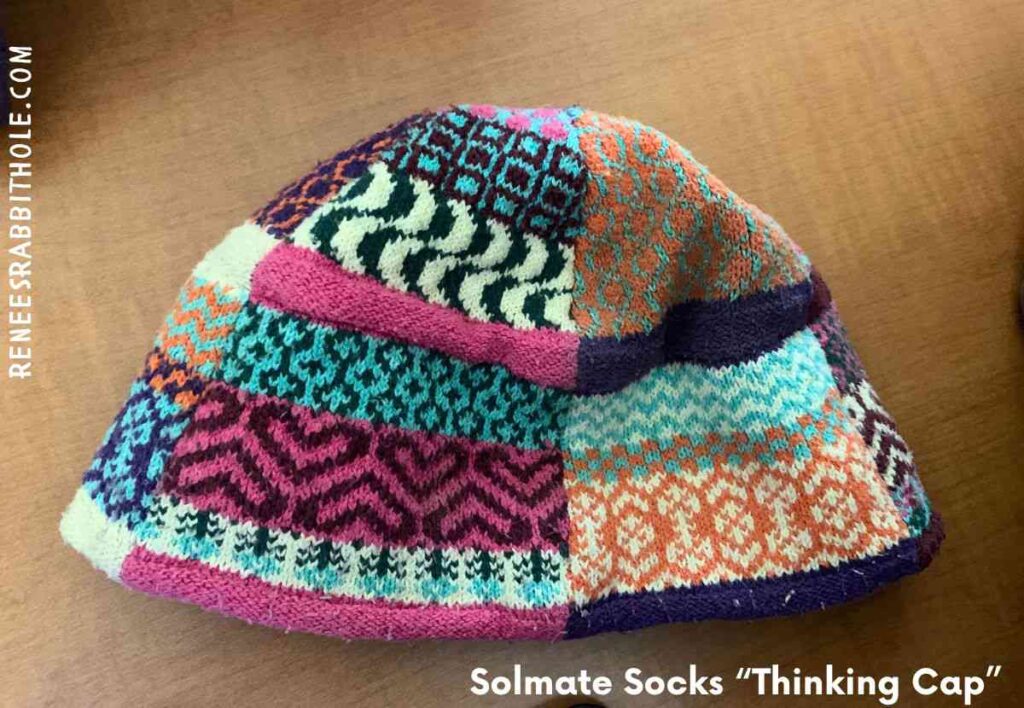
Although the term “thinking hat” is metaphorical, I went out and bought one. The company Solmate Socks, known for their colorful, fun sock designs made a marvelous line of them. They must have gotten out of the knitted hat business, but they are still out there on Poshmark and other second-hand clothing stores.
The funny thing is, I get compliments on this hat all the time. One day, when my husband and I were out and about doing errands, two separate people commented on how much they liked my hat! My hubby really got a kick out of that.
Is it any coincidence the bright colors match the energy and feel of my website?
Where does the term come from? According to Wordhistories.net, “The term thinking cap denotes an imaginary cap humorously said to be worn in order to facilitate thinking.” It earliest instance was found in 1821, with an even earlier mention of “considering hat” in 1605.
Conclusion
Can you crack your power clothing code? Only you know what you are comfortable in and what sparks your imagination. Experiment with what works best, and don’t listen to anyone if they have a problem with it!
Yours in creativity, -Renee