How many of you get stuck in a cycle of decision making? We over-analyze, procrastinate, dig in too far – the famous “analysis paralysis”.
Decision fatigue is real. It can lead to impulsive decisions and less confident choices that we later regret. Sometimes the right decision is not always the fun one. These situations can lead to overthinking and procrastination. Misguided enthusiasm can derail you as well.
If that’s you (and I bet it is) let’s crack the code into making the decision making process a little easier. With some practice, decision making can start to be resolved quicker and save you time.
Table of Contents
- Timing is everything
- Simplify choices
- Streamline
- Talk to yourself
- Bounce ideas off of others
- Pros and Cons
- Luck of the draw
- Under pressure
- Intuition and decision-making
- Really hard decisions
- The power of AI
- Exhaust all your avenues
- Conclusion
Timing is everything
I cannot tell you the speed at which I am writing this website. Actually, I’m quite astonished. There are a few factors in play.
I get up early and take one idea, and write an article. I do not venture into updating any other content – it strictly has to be new writing for that day. Other elements like images can be added later – they are just distractions that will derail me. I’ve figured out that the dead silence of the morning make the ideas flow effortlessly.
This works so well, that I can sometimes get three articles completed in a morning. If you take a lesson from “Habits of Famous Creators” you will see that it works.
Why fight something like that? I use the noiser, possible distracting parts of the day to tackle items that need much less focus. It is amazingly efficient to match up the activity with the time of day.
Thus, all of the micro-decisions involved with writing run smoothly for me.
Energy level and time of day
A 2011 study on judges determining parole decisions revealed that there were more favorable judgments made in the morning rather than the afternoon. The reason was attributed to decision fatigue, leading to more conservative choice in the pm session, even for the same crime and circumstances in the afternoon group.
This video suggests:
- make fewer daily decisions
- spread out your to-do list over multiple days
- don’t sweat the small decisions, save your energy for the more important ones
Another strategy from YouTuber Tim Ferriss is to make reversible or fixable decisions as quickly as possible. There are a lot of things that don’t need a perfect decision. He too, talks about conserving your energy for the more important decisions.
Training yourself to make those decisions quicker is a habit that can be formed. It actually makes you more perceptive when the stakes are higher.
Another perspective on this: imagine which decision you would regret (more) 3 years from now, 10, and 20 years from now.
Ultimately, delay decisions until you feel more rested and well. Mornings are better times when you feel more refreshed, or after that first cup of coffee.
Simplify choices
I’ve simplifed my choices. When one Youtuber talked about things that sped up her content creation. She was ruminating on too many choices, such as adding music to her videos. I realized I was getting hung up on that, too.
She impressed on me the need for speed in content creation. I get it, I’ve heard it before. It must be something about her personality or similar experience allowed the news to get into my Aztec Hole.
Making perfect thumbnails and featured images was a big time-suck. Actual content creation wasn’t getting done and I was losing my steam.
I decided to go with three basic and fun colors you see on my site: aqua blue, pretty pink, and happy yellow. It was a total gut instinct, I didn’t even think twice about it. I am a doodler at heart, and I really like the look of stick figures and sketchwork. It invokes an air of playfulness -something my curious brain is drawn to.
As it turns out, there are loads of stick persons and doodle artwork at my fingertips. I don’t have to stop and create it. That has been my problem my entire life – I’m certainly capable of creating things, but I could not access that my time was better spent elsewhere.
Think about it, that is a huge skill to grow on, a life-changing move that can make decisions easier. That, and asking for help when you need it.
I’m awful at asking for help, and just as equally awful at delegating. Ever the independent, I’ve finally figured out that it is one of my less-favorable character flaws. If you can acknowledge this in yourself, there are brighter days ahead for you!
I’m awful at asking for help, and just as equally awful at delegating – they’re one of my less-favorable character flaws.
-Renee’s Rabbit Hole
Streamline
Another thing that is speeding up my production time is putting systems into place. There are parts of image creation that I’ve chosen to stop doing, like putting my website name on each picture.
I’ve had problems with people stealing my content, so that was important on other websites I have. I figured that my minimal use of stock photos on this site didn’t warrant an ownership label.
In some rare cases, if I own the content, I will put my website name on there. I’ve also utilized quotes, to skip the whole process of locating images in the first place.
I have one goal, and that is speed.
Do I use AI? I’ve tried that with disappointing results. People want authenticity. Me being the control freak that I am, would edit it anyway.
I use AI as an idea starter, to flesh out a concept I have. I may use portions to enhance and article. I have a system and it is working beautfully, letting my personality burst through – which is so satisfying!
Talk to yourself
I am a big believer in talking to myself. That’s how my decisions get made, but even more, how I can talk myself out of a stuck decision pattern.
There are certain mantras that can save you in such scenarios. For example:
- Done is better than perfect.
- It’s good enough.
- Keep going!
Talking to yourself adds another person in the room when you need it the most! Otherwise we fall into our old patterns of not moving forward.
Bounce ideas off of others
When my daughter-in-law was trying to decide to stay home with her kids, she had a really hard time with it. The same with my son trying to figure out to junk his car or not.
They both used the same strategy: talking it out and getting other people’s opinions. It seems that being responsible for making a monumental decision causes paralysis.
It’s on us if we made the wrong decision. Having other people validate or offer fresh perspectives can help reach a quicker decision.
You can also post a quiz online and have family, friends, or people interested enough to particpate offer feedback.
Consult a professional
It’s a no brainer, there are experienced professional who you must consult at times. This is in reference to medical or legal guidance.
It’s one thing to go it alone picking out hamburger at McDonalds, it’s another thing to gamble on your health or fiscal well-being.
Pros and Cons
If you’re having problems making a decision, get back to the basics. Get a piece of paper and draw two columns and title “Pros” on the left, and “Cons” on the right.
You don’t have to complete your bullet lists in one sitting; take a few days to get through it.
YouTuber Tim Ferriss says rather than a pros/cons list, he prefers a risk/benefits list. He suggests writing down the best case and worst case scenarios with different options. This approach can bring to the surface the risks, and how much of a risk you are willing to take.
If there is a cap on the loss, you can identify if it is a mistake you can live with.
Luck of the draw
If you struggle at the most basic of decisions, you might need a decision aid to overcome the block. I would not recommend this for big life decisions (although some impulsive people might).
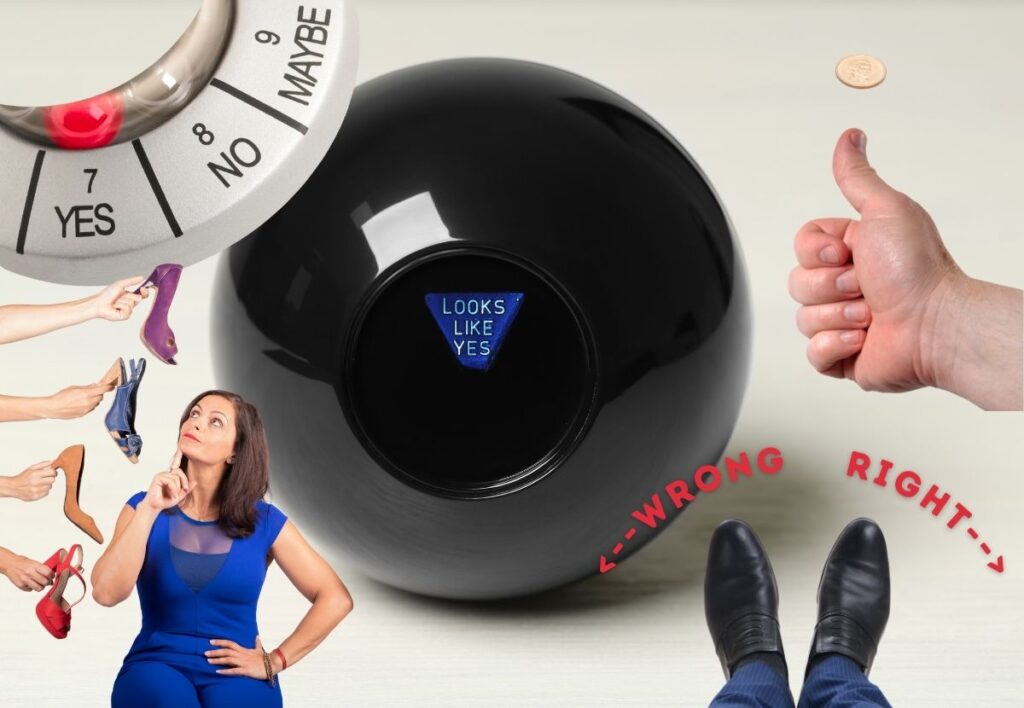
Rely on a Magic 8 Ball, a spinner, coin flip, dice roll, random number generator to make the decision for you. Don’t forget the popular fortune cookie route. The answer you are looking for might be hidden in there!
Even more random, let a pet pick out for you. Present options as treats or toys and see if your best buddy can make a better decision than you can.
Under pressure
Ah, there is nothing like pressures and deadlines to squeak out a decision. I think somehow we would like to go with “I didn’t have a choice – I had to pick!”. There is always that little bit of guilt haunting us about a poor decision made. We may feel that we could have made a better decision with more time.
However, you may make your best decisions under pressure. I’ve been trying to get better at not holding up the line at a fast food place, or any place. I’ve basically told myself I get what I get, whether I like it or not.
The social pressure I am holding someone else is too much for me!
Intuition and decision-making
YouTuber Tim Ferriss dips into the intuition side of things by talking about a “whole body YES”. Although there are multiple ways to use this technique, the simple idea is to scan your head, chest (heart), and gut. Look for a “go signal in all three areas, Tim says a “yes” in all three areas is the only time you should go with a yes.
Tim admits he has a hard time discerning the “yes” signals. Instead he relies on the “no” signals. For example, a contraction or grinding in the ears, a contraction in your chest area or gut – it’s a “no”.
If ultimately you decide that it’s a good idea, but it still feels off, you should say no – especially when it involves people. If intuition is pointing to a different direction than your analysis, than don’t proceed, say no. Even if you want to do it, Tim feels it’s better to say no.
Don’t use intution as an excuse to do what you want to do. Anybody can use intution to rationalize their actions, without doing the real intuition work. Also, intuition is best used in conjunction with a risk/benefits list (Tim endorses that method as well in the video).
Beware that it can be hard to work from intuition, with the daily noise and competing information we face everyday. Also pay attention if the decision is made out of fear or greed, time spent with intution may be off-kilter.
TIP: the more calm and centered you feel, the better intuition works!
Really hard decisions
Not all of our decisions are black and white. Some carry layers that make reaching a decision more difficult. For more complicated decision-making, it’s important to tap into your subconscious.
Being too analytical in your decision-making approach can block you from making decisions in an effortless and more intuitive way. Rian Doris explains that entering a flow state can make decision-making much easier. Rather than intensely deliberating with your inner monologue, the subconscious can step in, making faster decisions.
He encourages learning how to make flow-like decisions outside of the flow state. It begins with identifing the problem. This can lead to reframing it, which helps come up with new perspectives on how to solve it.
Rian then encourages after identifying the problem (externalize it), to write it down. Then step away from the problem and surrender it to your subconcious, such as taking a shower. This incubation period could take hours, days, months.
If the decision has to be made right away, take a quick physical activity break, such as a walk, to stimulate the subconscious mind. Return to the decision after a period of time, and you will find the answer to the decision starting to break through the uncertainty. The answer can even appear more clear than you ever thought it could be.
The power of AI
I might be the first person ever to suggest AI in making a decision. I actually did have a tough decision to make, and I followed the advice of my own article. I did not receive the “whole body YES” and I knew why.
I thought, what the heck, I’ll throw it into Microsoft Copilot. My brain knows to reject an “off” answer. The results were actually pretty comforting (I can’t believe I’m saying that).
Without revealing too much of a very private decision, I entered a paragraph about what I wanted to do, and why I was really afraid to proceed. I then asked Copilot to give me advice on it.
- AI used active listening skills – this means that the heart of the problem as I provided it was stated back to me.
- It validated my genuinely excited feelings about the project.
- AI gently acknowledged my concerns, but told me that the regrets of not doing it would feel worse than any comment the outside world gave me.
- AI also gave common sense advice: test the waters, see how I feel, allow myself to get more comfortable.
Finally, AI left me with the thoughts, “If you find you enjoy the process, or find success, you will have more confidence in talking to the naysayers.”
I then pressed AI once more, telling it that I was also scared because my ADD-brain has a history of not following through, I feel my inner circle has lost confidence in me. Wow, it came back with “ADHD can make it harder to stick with long-term projects, but it doesn’t mean you’re incapable of success.”
Now I totally got sucked in and became very honest, I mean, it’s just the two of us, right? I felt even more vunerable, but let honesty rule. I got a very honest answer back.
The whole experience was like practicing a hard discussion I needed to have. Maybe it won’t be that way in real life, but it was really helpful.
Exhaust all your avenues
I, unfortunately, resort to the tactic often. I can research something to death, I have all my papers printed and marked up, helping me to make a purchase.
It’s part of my pet peeve, making a bad purchase. There is no harm in the strategy for the big decisions or purchases in your life. They do warrant more time and consideration.
I find that for a purchase, when I start seeing the same Youtube video or blog post in support of a product, it starts to seal the deal for me. However, buyer beware, some of these posts benefit the creator in terms of affiliate income, and they might not be giving a full, unbiased review.
Don’t forget that you can visit online forums and post questions. This is another valuable strategy to help with the decision-making process.
Conclusion
When we rely on ourselves to make decisions, we are in a vacuum. We lack the perspective that outside opinions can bring to the decision-making process.
Decision making is a problem for all of us when it significantly slows up our journey to the other side of the outcome.
You have better ways to spend your time. Consider the techniques mentioned, or offer your own successful strategies below!
#inthistogether -Renee