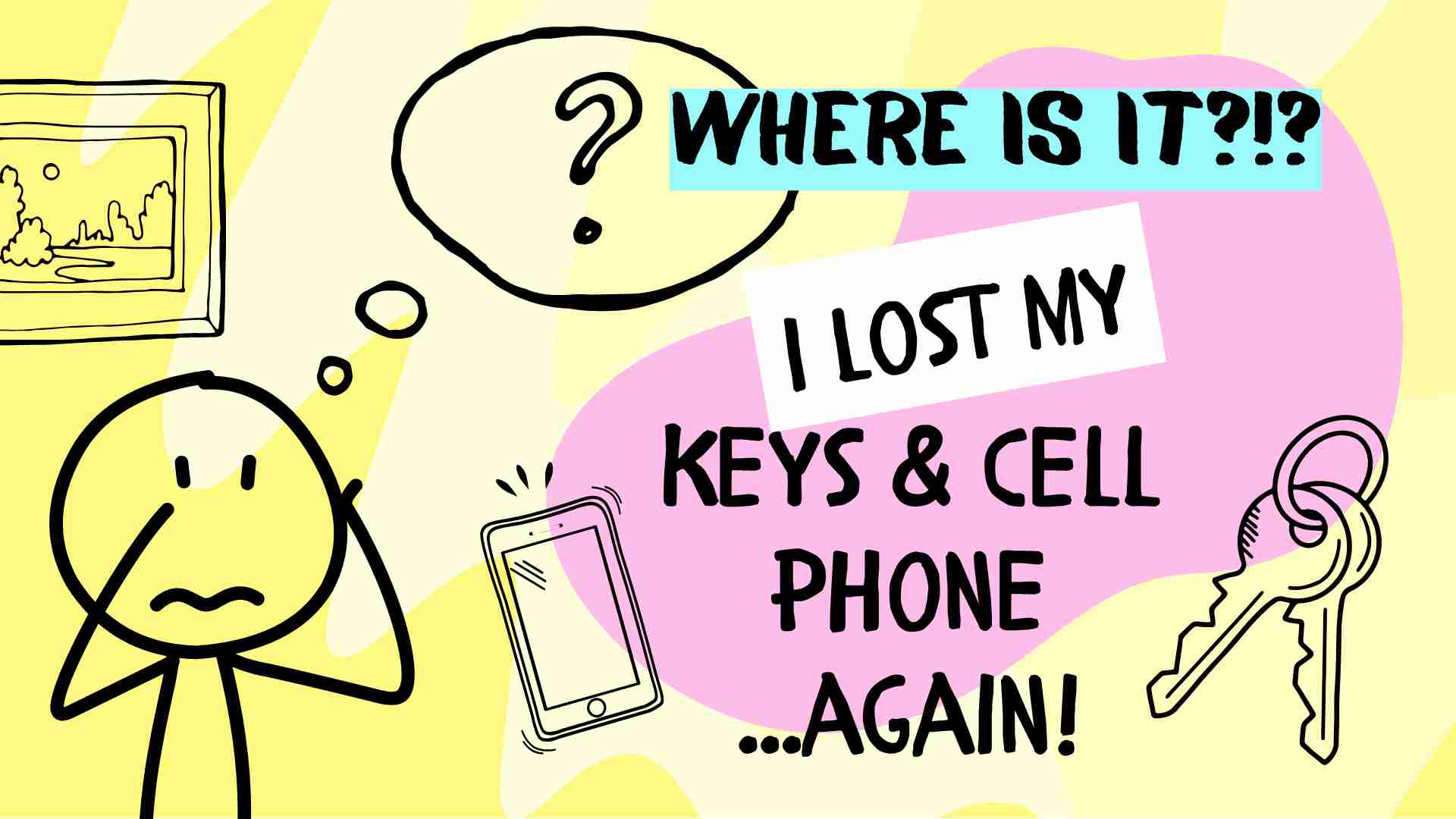
The pain is real! I’m sure it seems to my family that I lose my phone and keys daily – especially my phone.
The frustrating looks of a family member can grow old. They hate to be dragged into the “great hunt” for your missing stuff once again. Misplacing my stuff… is like a lifestyle. Believe me, I get frustrated at myself, does that sound like you, too?
It’s not that you’re careless; it’s that your brain is wired to focus on what’s most stimulating in the moment, often at the expense of remembering where you put your belongings.
So, why do ADHD brains have such a hard time with this? Executive function—the mental processes that help with planning, organization, and self-monitoring—can be a bit of a rollercoaster. For some, it means setting items down in random places without registering where they were left. For others, it means forgetting the mental steps needed to keep things orderly.
Understanding ADHD and Forgetfulness
ADHD affects the brain’s executive function, the system responsible for planning, organization, and impulse control. When executive function is impaired, everyday tasks—like keeping track of belongings—become surprisingly difficult.
People with ADHD often struggle with object permanence, a cognitive skill that allows the brain to remember that something exists even when it’s out of sight. If an item isn’t immediately visible or in a designated place, it might as well have disappeared into another dimension.
Additionally, working memory—the ability to hold and manipulate information in the short term—plays a crucial role. ADHD makes working memory unreliable, leading to moments of, “I’ll remember where I put it,” followed by complete and utter confusion minutes later (that would be me!).
Another common issue? The “ADHD hyperfocus” effect. When people with ADHD become absorbed in an activity, everything outside of that focus—like keeping track of a phone or keys—gets neglected. Suddenly, a crucial item is missing, even though it was just within reach.
Practical Tips to Stop Losing Your Stuff
I love, love, love the Holderness Family videos on Youtube. They crack into everyday, family humour, even putting it to a tune. Penn Holderness, the dad, openly makes fun of his ADHD tendancies. He shares practical brain hacks that help him in this area.
I’m going to mention some of Penn’s strategies, but throw in some of mine, as well.
But first off, don’t overlook the basics. Rachel Papworth, a home organizer, suggests always taking a deep breath to calm yourself down and before going into each room before searching for it. She also suggests looking in the general area where something is lost – keys could have gotten knocked off a hook or a phone fallen out of a bag, or kicked under a couch.
And last of all – look where the object belongs, you might be surprised to find it there!
1. Preventative actions
Keep your environment tidy (I know that’s a lot to ask). It’s easy for a cell phone to get shuffled underneath something. like a mess of open newspapers.
Take actions that can stop potential problems later. I moved a garbage can in my home office away from a desk. It was too easy for an important paper to fall off and into it. That’s exactly what happened at my workplace, some keys fell into the recycling bin next to my desk. Luckily, it popped into my head to look in there the next day.
In the phone section, I talk about having an easily identifiable and colorful phone. It helps you find it easier, but you can also describe it to others. The same way with your keys, add colorful bling-blings to them.
We need all the help we can get!
2. Keep essentials out in the open
Instead of storing your phone or keys in drawers, keep them in open areas where they’re easily visible. ADHD brains rely heavily on visual memory, so having items in sight reduces forgetfulness.
Ever experience the “Right in Front of Me” phenomenon? Sometimes, an item is right where you left it, but your brain simply doesn’t register its presence. This is why you can check the same spot multiple times before finally spotting what was there all along.
All I can say is “guilty!” on this one. In this instance, your patient family can assist.
3. Avoid “temporary” placement
A common ADHD mistake is setting an item down just for a second. That second turns into hours, and suddenly, the object is lost. Committing to putting things in their designated spot immediately reduces the likelihood of losing them.
I know this happens to me because of “trailing” – I leave the phone somewhere along my trail of activities. It was the famous Benjamin Franklin that declared, “A place for everything and everything in its place.” That advice still rings true today.
By the way, this founding father of the United States was one of the most famous polymath’s, a person with a wide-range of learning or knowledge – just like you, he had an insatiable curiosity thirst!
“A place for everything, and everything in its place”
-Benjamin Franklin
4. Lists and bells (post-it notes, too)
Leave yourself a post-it note as a gentle reminder NOT to forget something. It doesn’t help in locating a lost object, but as far as getting out the door in the morning, it keeps everything running like a well-oiled machine.
Penn even suggeted to have other people write your reminder lists. His wife understands the way his brain works and supports him in this area.
Making item-checking a habit can help reinforce memory. Before leaving the house, go through a mental checklist: Keys? Phone? Wallet? Over time, this practice becomes second nature.
Don’t overlook other handy tools to poke at your brain. Scheduling alerts on your phone, with a note of explanation, can offer another boostful reminder (I made that word up!).
5. Make the hunt electronic
It’s a great time to be a scatterbrain! Now there are electronic locaters to keep tabs on your luggage, wallet, phone, and TV remote controls. Heck, you can even slap one on your dog if you’re afraid they are going to run off.
These little devices are such a great idea, that I wrote an entire article. Learn more about these amazing gadgets, and all the forms they come in: “Electronic Trackers: Life’s Little Helpers.”
Maybe it’s time to invest in a metal detector, too. Check out my article “Metal Detectors for the Lost & Curious.”
I’m confident that your outside-the-box thinking will come up with additional ways to use these gizmos.
6. Go cheap on expensive stuff
Penn recommends buying multiples of commonly lost items, such as cheap sunglasses. Avoid investing in expensive glasses, especially if you already have a track record of losing them.
In regards to his wedding ring, he no longer wears it. He says that he has lost many, expensive replacements. Thank goodness for the trend of neoprene wedding ring bands. This can completely remove the stress of keeping track of wedding rings.
I leave my wedding ring on all the time. When I do take it off, I’ve trained myself to always return it to the same trinket dish in my bedroom. I gifted a beautiful trinket box from my mother to my daughter when she became engaged, giving her the same assigned drop zone.
Other alternatives are to wear the ring on a necklace. Some people have chosen to tattoo an “ink ring”, monogram, or other meangingful symbol over their ring finger. Now that’s committment to the relationship!
In terms of other valuables, I suggest you take pictures of it, so if you do lose it, you can share the picture with others.
7. Case of the missing keys
In my workplace, there will be an occasional key ring bunch, set out on a table for staff to identify. Labeling the key ring would have easily bypassed the stress the owner was going through finding them.
There are lots of actionable steps to reduce the risk of losing your keys:
- Make it a bigger, more visual target by adding key chains and trinkets to it
- Attach a key finder
- Post a designated place in your house to set the keys, like a key dish, counter in kitchen, or wall
I picked up this magnet key holder. I have one on the side of my refrigerator, and one on the side of a metal cabinet in my basement entry. Having a home for keys is a game changer!
Labeling keys is a good habit to get in to. By adding a name and cell phone number, your chances increase to get them back. If you pick up colored plastic key tags, you can even color code per vehicle.
I have a designated spot in my purse where the car keys go, and another designated spot for my house and office keys. My remote key doesn’t have to leave this spot, and I can just grab my big purse (big target 😉 every morning and I’m ready to go.
My family knows my system, they can grab the car key from my purse if the other key goes missing on the key holder. There is always clapping or whistling to find your phone. Check out these videos on youtube to find out more.
8. Anyone see my phone?
Ugh! This is the bane of my existence!
Penn chooses to use an extra big cell phone (about the size of a brick). He says now is not the time for a trendy, sleek model. The bigger version is harder to lose.
He also talks about the frustration of leaving it in a cab or Uber, making it much harder to get it back. My sister-in-law accidentally left her cell phone in a cab in Spain. Not fun, especially when traveling.
Find My Phone and other similar apps can give you a shot at finding a missing phone back. Once my son lost his phone out in a Midwest cornfield. We had just planted it and thought there is no way we were going to find it back. I turned on the phone locater, and we found the phone on the edge of the field, 10 feet away from what the app indicated.
- Find My iPhone / Find My Device – Built-in phone-locating features
- Samsung Galaxy SmartThings Find – Helps locate lost Galaxy devices and SmartTags
- Apple Watch Ping Feature – Sends an alert sound to a misplaced iPhone
Other helpful strategies: set a homescreen picture so anyone finding the phone can identify the owner and return it to them. Avoid a generic black case at all costs! Find a flashy, one-of-a-kind case so you can easily describe it to someone.
There is always the tried and true label on the back to help the good Samaritan who attempts to return it.
9. Color matters
Ever consider how all technology things are colored black? I look for brightly-colored options to prevent “the black blend”.
Speaking of black, black clothing is the worst. I now keep all of my casual black clothing together in a drawer (slacks are hanging up in the closet). My life became much easier to find a piece back. I also don’t have a lot of black clothing, but it’s so irritating not to find the black undershirt you’re looking for.
Take deliberate action to color code things, slap hot pink duct tape on something important, use special colored binders to identity special papers. I use bright orange folders marked “Taxes”. When tax papers come in the mail, they go right into these folders. Losing them is not going to happen on my watch!
10. What you wear matters
Clothing. Penn recommends cargo pants. The pants offers plenty of pockets to store keys, phones, and anything else. Plus, chances are, they stay on you and go everywhere you go!
Travel jackets are another article of clothing that sports multiple pockets. Consider crossbody antitheft bags when traveling and hoodies with zippered pockets.
Also consider high-visibility vests and reflective clothings to help see these items easier if they are misplaced.
You might want to look into a company called SCOTTeVEST, that specializes in clothing with pockets, particularly vests, jackets, and pants. They feature numerous pockets and compartments for organizing electronic devices and personal items. Their marketing is so cute, “It’s not Rocket Science. It’s Pocket Science!”
Accessories. Make your purse ground zero. Use zones in the purse that your brain likes, so important things always have a home. Lanyards, fanny backs, and belt bags help keep your items secure and accessible.
11. Car woes
Penn Holderness is notorious for forgetting things in his car and on top of his car! One time, my mom left some clothes she just bought on top of her car, and took off out of town. A cop picked up the clothes later – true story!
Penn has come up with some pretty creative ideas for a very real struggle. He put a tiny little magnet on top of the car roof (on the outside). It serves as a reminder to him to grab the basics: the keys, the phone, the coffee mug.
By the way, Penn wrote The Car Song about remembering glasses-wallets-keys-and-phone set to the tune, “Heads, Shoulders, Knees, and Toes” – Penn uses his superpowers for good! Feel free to listen – I’m sure you won’t be able to get it out of your head!
12. The paper chase
Being intentional is especially beneficial when it comes to paperwork. So many times an important paper randomly slips into somewhere it shouldn’t be.
This can be avoided by clearing a table and having only the important paperwork in front of you. This is not a good time for messiness!
Having lots of empty space can help. This allows you to push the papers off into a corner, and bring another paper out (with more space around it) to manage or process the paper.
I use the same method for paying bills. So often if I have more than one bill and soon misplace the return envelope, or papers get switched. This system has saved me much frustration.
Don’t forget landing places! Assign the places where important papers need to go, like a file cabinet.
13. Resort to the novel
The cool thing about my website is that I don’t have to answer to anyone! If my brain wants to offer my curious audience unusual solutions, I can go there. Keep an open mind on the following ideas to find your lost things.
Subliminal techniques
Did you know that there are subliminal ways to find your keys? Wild, right? It was fascinating to read viewer comments in the video about their success with listening and then finding their lost object.
Goddard technique/tapping
Or… you can imagine a lost or stolen item back. Yes, that’s right! It’s called the Neville Goddard technique. Basically, you use visualization to vividly create location points to retrieve the lost item. Some people may even resort to the power of hynosis to find the unfindable.
A twist on the Neville Goddard technique is tapping. It’s based on that everything has a answer, but our energy is closed off to it. Basically, you need to open up your energy to receive the answer. Who doesn’t get frustrated, angry, and anxious when you’re trying to desperately find something back? Tapping with Kelly is a youtube site that focuses on this tapping technique
Folks, I have never heard of this before! If you’re interested in it, visit Kelly’s Youtube video “Finding Lost Objects with EFT/Tapping – Tapping With Kelly”.
Spiritual guidance
Many people choose to take the spiritual route. For angel lovers out there, Archangel Chamuel can give assistance for lost items through a meditation. In the Catholic faith, St. Anthony is said to be the patron saint of lost things.
Use this catchy prayer to envoke his help, ““Dear St. Anthony, please come around: something is lost, and it cannot be found.”
People will also send a plea to their deceased loved ones to find lost items. Ultimately, it’s a personal thing. Find the method that resonates with you!
14. When truly lost
Retracing your steps and talking openly to yourself seems to stir up the memory of where the last place was that you looked for it. It’s common for me to say out loud, “Now, if I were a pair of keys, where would I be?” It beautifully re-focuses you. Many times, out of stress, we can’t think clearly enough.
Penn, pro ADHD-hacker that he is, recommends looking near food. That is where he most likely forgets a phone – brilliant. Check the refrigerator, kitchen counters, and the pantry. It’s been a long time since I put an office object in the refrigerator, so I must be making progress!
Give it time
Sometimes when you’re not trying so hard to find something, your missing item shows up.
Sometimes, things really are lost. Consider the case that someone moved it and didn’t tell you, or it might have accidentally been thrown away. Keys could end up inside a jacket pocket from last winter, and wallets mysteriously migrate to the back of a kitchen drawer.
The frustration of a forever-lost object is universal. You can commisserate with the rest of the population on National Lost Sock Day (May 9) or Official Lost and Found Day (according to Time and Date, this unofficial holiday is celebrated the second Friday of December).
Personally, I always thought these holidays should be shared with Festivas, the holiday established on the fictional TV show Seinfeld. One important part of the holiday is the “Airing of Grievances,” It’s supposed to be an opportunity to tell others how they have disappointed you in the past year – my grievance would be about my lost stuff.
In the end, you have to have a sense of humor about it!
Conclusion
Lost stuff is certainly frustrating. Don’t be too hard on yourself and your brain. These ideas and tips are meant to empower you.
At the end of the day, this little frustration doesn’t define your intelligence—it’s just part of how the ADD/ADHD brain operates. So whether your phone ends up in the freezer or your keys mysteriously teleport to the bathroom counter, take a deep breath, laugh it off, and try again.
And if all else fails, remember: There’s always the couch cushions.
#inthistogether -Renee